Posts

Showing posts with the label Cause and Action

The Nature of Mind

Image
Does the mind have a form or is it formless? Can it be identified with the chemical mechanism of the brain or is there something more to it than that? What are its causes? Is it hereditary? These are some of the questions that we are going to probe in the course of our investigation here. In Buddhist writings, the mind is defined as a phenomenon which is formless and possesses the dual nature of clarity and knowing. The first characteristic (clarity) speaks of its quality of being luminous and clear; clear in the sense that its fundamental nature could never be defiled or polluted by negative influence. Emotions, such as desire, hatred and anger contaminate the mind and hold constant sway over it as our own personal experiences testify; the pollution is, however, only at a superficial level, for they do not penetrate into the core of the mind. In other words, these negative emotions are not part of the intrinsic nature of the mind. Irrespective of how forceful one's experi...
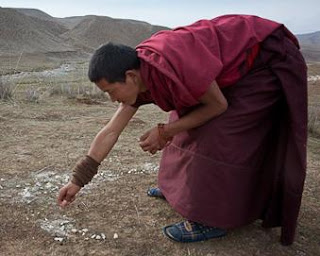
The sami who rescued the ants

Image
A little monk who is not old enough to become ordained is called a "sami". Once, there is a little sami who studied Buddhism with a very wise Teacher. He was a very good student. He was respectful, sincere and obedient and had learned very quickly in his daily Buddhist studies. The Teacher was so wise that he could foretell the future, where he knew from the beginning that this little student could not live very long. One day he counted and realized that the little student had only seven days left to live. He felt very sad upon his findings. He later called the little sami and said to him, "little same, you haven't seen your mother for long time. I think you need a vacation. You run on home and visit your mother and come back eight days from now". He did this so at least the little sami could die in his own parents' house. When the little sami left for home, the Teacher was very sad. He thought he would never again see his little student. Eight days later, t...

The Giving of Fearlessness

Image
Another way we can give is to relieve the worries and fears of others. A friend told me of an incident that had occurred in her home. A caring woman with an excellent sense of humor, she does draw the lone at some things. Upon walking into her bathroom, she saw a large python on the floor. Having good reflexes, she drew the line and firmly closed the door. Knowing that she was not at risk, her immediate thought was for her elderly cat that could no longer move quickly. Jenny, who is a Buddhist by practice called her husband Rob, who is a Buddhist at heart. Rob look into the phone book and locate a snake catcher. However, before the snake catcher was allowed to leave the premises with his catch, Rob thoughtfully queried the man: Was the snake okay? How would it be released and where? Would it be safe or would it subject to any risk? The snake catcher patiently explained that he would take it a considerable distance away before he would release it in a safer and more natural environment....

Dharma Talk on "Karma or Cause and Effect"

Image
Sunday, June 5 · 8:30pm - 10:30pm Venue: NGEDON TENGYE LING BUDDHIST SOCIETY at 39 Persiaran Medan Bercham 3, Pusat Bandar Baru Bercham, 31400, Ipoh, Perak. About the Dharma Master Khenpo Yeshi was born into a noble family in Kham, East Tibet in 1969. From early childhood, he showed a deep interest in the study of Dharma. Tibetan Dzogchen master, H.E. Lungdok Rinpoche, as well as H.E. Khenpo Könchok Gyaltsen took a personal interest in guiding young Yeshi and, at the age of thirteen, he was granted empowerments, transmissions and oral instructions in the cycle of sNying thig. Arriving in South India at nineteen, Khenpo Yeshi went to Sera Monastery. He continued to excel in his academic studies, ascending to the top of his Shedra classes. Later, he entered Dzogchen Monastery in order to complete his studies in both the Sutra and Tantra trainings. Over the years, Khenpo Yeshi studied closely with more than two dozen eminent Khenpos, including H.E. Khenchen Meiwa Tubten Rinpoche and H.E. ...

Emptiness and the Middle Way

Image
The above two aspects of Emptiness should be realized together as they balance to show the Middle Way beyond all extremes. Realizing the first aspect of Emptiness without the second can lead one to be greedy and selfish-falsely, believing that all pleasures and material things are "real" and lasting. Realizing the second aspect without the first can lead one to be pessimistic, passive or immoral, falsely believing that nothing is worth striving for as everything is hollow and meaningless. It is therefore very important to see both of these aspects together in order to function with Wisdom in a balanced way in everyday life. One should learn to perceive everything as they are while knowing the true nature of their existence. One who realizes Emptiness is able to live positively with great ease and freedom, treasuring everything without attachment. Emptiness is not Nothingness Emptiness does not mean physically or mentally nothing or nothingness - it is the law of total opennes...

Emptiness

Image
Emptiness (Sunyata in Sanskrit) being one of the most profound truth in Buddhism, is often misunderstood. Sunyata is at best, though not ideally translated in English, as Emptiness. Though this might seem vague it is a very practical truth helpful to us in everyday life. Examples of Emptiness An analogy to explain Sunyata is a river. A river does not truly exist on its own as it consists of many streams of water coming and going, that make up its substance. Each of these streams is just unsubstantial, each consisting of smaller and smaller streams within it as substance. There is not substantial or real river - there is only the flowing. We say that the river is empty of a real fixed nature - exhibiting Emptiness. Everything in the Universe (all physical and mental phenomena) exhibits characteristics of Emptiness. Another example is a waterfall. A waterfall seen from a distance appears like a shiny solid sheet in one complete piece. But upon closer inspection, we see clearly that the p...

Dependent Origination and Relativity

Image
The Law of Dependent Origination is a realistic way of understanding the Universe. The fact that everything is nothing more than a set of complex relations is consistent with modern scientific views (such as Einstein's Theory of Relativity and the Quantum Theory). Since everything is conditioned, relative and interdependent, there is nothing in this world which can be regarded as permanent entity with a permanent identity. Things are what they are and only in relation to other things. For example, one is not independently or by nature a father - he becomes a father because of his relation to his son. A man who is a father to this son is also a son to his father. His identity is relative and depends upon his relation to another person. Terms like long and short, high and low, father and son, etc are relative and only make sense in relation to other things. Relativity means that because each thing does not exist independently, it does not have an unchanging nature of its own with any...

Dependent Origination

Image
The Buddha often teaches in terms of Dependent Origination. Through the understanding of Dependent Origination, the Buddha attained Enlightenment. He said "Deep indeed Dependent Origination. It is by not realizing this principle that all have become entangled like a ball of thread, unable to stop suffering and rebirth." The Law of Dependent Origination The basis of Dependent Origination is that life and the world is built on sets of relations, in which the arising and cessation of factors depend on some other factors which condition them: When this is, that is This arising, that arises When this is not, that is not This ceasing, that ceases "This" + Certain Causes + Certain Conditions = "That" On this principle of interdependence and relativity rest the arising, continuity and cessation of existence. This is called the Law of Dependent Origination. It emphasizes that all phenomena in the Universe are relatively conditioned states and do not arise indepe...

Equanimity

Image
Equanimity is the attitude of regarding all sentient beings as equals, irrespective or their present relationship of oneself. While equanimity counters clinging (craving) and aversion, it is not cold or indifferent - it is love that is impartial and without prejudice. When a grown up son settles down with his own family, he begins to lead an independent life with responsibilities of his own. Although his mother still has her feelings of loving-kindness, compassion and appreciative joy towards him, they are now combined with a new feeling of Equanimity. She recognizes his new independent and responsible position in life and does not cling to him. To become a sublime state of mind, the attitude of Equanimity has to be extended to all sentient beings. In order to do this, one needs to remember that one's relationship with one's relatives, friends and even enemies are the results of previous Karma. Thus, one should not cling to relatives and friends while regarding others with ind...

Does Dana prolong samsara?

Image
Some have the wrong belied that dana prolongs samsara (cycle of rebirths). In the story of the two friends, we have seen that the one who gave charity was not late in attaining nibbana. Therefore, it is illogical to assert that dana prolongs samsara. In fact, the impurity of the mind of the donor responsible for the round of rebirths. One's lustful greed to enjoy the luxuries of humans and devas for the dana given causes one to linger in the cycle of samsara. Some erroneously say that Buddha himself has to struggle loger in samsara because he cherishes dana in every existence. This is absolutely untrue. Due to dana parami (perfection of charity) an infinite number of Buddhas have attained supreme enlightenment while we all are still swimming along the stream of death and rebirths. Can we attribute this to our danas which far exceed those of the Buddhas? The Bodhisatta Vessantara who gave charity in an unprecedented magnitude attained Buddhahood after only two existence. Therefore i...

The Benefits of Dana

Image
The benefits of Dana need no elaboration. The good deed of feeding a small animal just once brings about long life, beauty, prosperity, strength and wisdom for the next one hundred existences. When reborn in human or deva world, due to his dana in this life, he outshines other beings. In the time of Kassapa Buddha, there were two monks who were good friends. One of them was a generous donor while the other was not. Since both observed sila (precepts), they were reborn as human and deva up to the time of Gotama Buddha. In each and every existence, the generous always excelled the other in status. In their final existence, they were both reborn as humans in the court of King Kosala. The generous donor became a prince while the other became a son of a minister. While the prince slept in a golden cradle under the regal white umbrella, the other slept in a wooden cradle. Although both attained Nibbana ultimately, the benefits they enjoyed in each existence were quite different.

No one can cause us psychological pain

Let us look at the idea that no one can cause us psychological pain, starting with some reflections. Can you recall an incident when someone said something to you that you experienced as painful, either a small slight or an insult? What is your reaction: Irritation; indignation; self-justification; full blown anger? Were you aware the hurt you felt? Or did you quickly pass over that to anger? Was it only afterward that you felt the hurt? What did it lead to? An angry exchange? A long hostile relationship? Slander? Has anyone ever attacked you physically, perhaps as mild as a shove in a queue? Or has someone in a rush pushed you out of the way? Maybe someone has hit you or thumped you on the nose? What was your reaction? Was there any different from the above but simply more intense? Was there a desire for revenge? Can you recall an incident when you said something cruel to someone. Just a quip but it was meant to sting. How did you feel immediately afterward? Satisfied? Well-pleased? A...

Death Proximate Karma

Image
As Buddhist, we should remember and comprehend well the working of the Death Proximate Karma, without forgetting that the Habitual Karma is also important because it is a lifetime karma that we depend on for our next rebirth which is created by accumulating our good or bad deeds. Here are some instructions for the dying: 1. Do not get angry - pay attention to your dying moment. If you are angry or mad at this moment, you will be reborn in the lower realm. The best is to concentrate on reciting Amitabha Buddha's name continuously. 2. Forgive and forget - do not think of your enemies or vengeance because you will be reincarnate and take revenge on each other endlessly. And if this happens, you will accumulate more negative karma onto yourself and cannot go for the right practice. 3. Do not become attached to loved ones or your wealth as these attachments will lead you to lower realm i.e. animal realm. In the story book of the thirty three Zen masters, there is a story about one of th...

The Realm of Gods

Image
The realm of the Gods (God here does not refer to an almighty creator) or the higher heavens are different planes of increasing refined levels of sensual bliss and gratification. Gods are able to enjoy beauty by their own goodness. They are beings with beautiful subtle bodies who delight with music and dance, and exist in extended peak experiences in which one dissolves into experience of pleasure, merging with the beloved, temporarily crossing the boundaries of ego. Such experiences can be cultivated in meditation but are dangerous as they induce complacency with what is only temporary. After a long time, the gods will fall from their state of bliss. Unless they realize their impermanence and start living the spiritual life, they will be reborn into the lower realms when they had depleted their positive Karma in Heaven. Gods in our World Human Gods such as Kings and Queens in earlier times live in a royal life full of wealth and power. They are able to satisfy any desire at their comm...

Am I a Demi-God?

Demi-gods are always trying to be cleverer, or stronger or wealthier or more experienced than others. Each watches for others to weaken so that he can seize power for himself. Although trying to prove their superiority, they are very conscious of hierarchy and tend to form ordered power structures, allying with others to scheme against others - ultimately for themselves. They are able to relate to others only on basis of dominance or submission, not as equals and where they can, they will dominate. Backstabbing and conspiracy is common. A human is and can be reborn as a Demi-god if he is egoistic and power crazy. However, he would also need some positive Karma to be reborn in a Heaven as it requires much merit. Such person is however dominated by the mental state of Craving and Aversion as his merit is without Wisdom. One who dies tuned to this mindstate is likely to be reborn as a Demi-god.

The Realm of Human Beings

The Human realm is the world of our everyday experience. It contains all the other realms of existence that humans create for themselves. This is the realm where the individual searches for self. Humans are fundamentally unsure about the nature of many things - including his true identity. But it is in this world that transcendental insight into the true nature of self can be attained. This is the world where the individual can be conscious enough to be aware of his state of dissatisfaction and seek liberation, becoming enlightened, freeing oneself from the wheel of life and death. A truly living human person is one who realizes his special position and treasures it, as it is not easy to be reborn as a human. We must not take this life for granted, not realizing its significance. The human realm is the most favorable realm as it contains a mix of pleasure and pain - giving us ample opportunity to realize the true nature of life. Rebirth in the other realms is unsatisfactory as constant...

The Realm of Animals

The world of animals is that of instinctive gratification of the biological drives of hunger and sexuality. All endeavor is directed to the satisfaction of physical desires and self-preservation. This world is of the ignorant refusal or inability to see beyond the natural needs of the body. A human can be reborn as a certain animal if his character and habits resemble it. "Human-animals" also exist in our world - a couch potato who only eats, sleeps and watches television all day might gradually resemble a pig and become a "good for nothing" being physically lazy and mindless. A viciously jealous and suspicious person could miserably small and thin, resembling a poisonous snake in appearance and nature. The "Human-animal" is the one who willfully refuses to look at the meaning and purpose of life. His bodily needs for nourishment, sleep and sex might be healthy and he gets satisfaction and enjoyment from them. But their fulfillment becomes an end to itself...

Hungry Ghosts in our world

A 'human hungry ghost' is the miser who lives for more and more money at the expense of everything else, falsely believing that it will bring him true happiness. Another hungry ghost is a drug addict who can barely keep himself alive and is only concerned with getting his next dose, whose effects soon fade away, leaving him longing for another. Two neurotically dependent lovers might also be hungry ghosts if they keep trying to get something from the other, which the other might also lack. Some people are also possessed by neurotic craving and longing out of inner emptiness that they live only to gather material things or emotional experiences (or assurance) for themselves. Even if they get what they want, it gives them little pleasure. No matter what they possess, they always feel that there is something missing. The people crave for certain experiences to feel real and substantial are distracting themselves momentarily from their repressions and lack of spirituality. Such peo...

The Hungry Ghost Realm

The dimension of hungry ghosts realm is of phantom-like creatures representing a mix craving and hatred. Tormented by unfulfilled cravings and insatiably demanding of impossible satisfactions, they are beings with having terrible emptiness within themselves who cannot see the impossibility of getting something that has already passed away. Their ghost-like state represents their attachment to their past. While being impossibly hungry and thirsty, they cannot eat or drink without causing themselves terrible pain or indigestion. Their long thin throats are so raw and narrow that swallowing produces unbearable burning. Their bloated bellies are also unable to digest nourishment.

What does Rebirth explain?

Karma and rebirth together explain many unresolved mysteries. the inequality of mankind and their experience (even twins are different in character) talents of geniuses and child prodigies spontaneous arising instinctive likes and dislikes in infants intellectual differences between parents and their children sudden outburst of emotion and changes in character untimely death and unexpected changes in fortune