Posts

Showing posts with the label Paramitas

What are the Paramis?

Image
The answer to this question is, the noble qualities such as generosity, morality, etc, etc, not spoiled by craving, pride or wrong view, but founded on great compassion and wisdom which is skill in seeking merit, are to be named Parami. Further explanation, when giving dana, if it is tainted with craving, thinking "this is my dana", if it is tainted with pride, thinking, "this dana is mine", if it is tainted with wrong view, thinking, "this dana is for myself", such dana is said to be spoiled by craving, pride and wrong view. It is only the kind of dana not spoiled by craving, pride or wrong view which could be termed Perfection (the same applies to observance of morality, etc). To be qualified as a Parami, acts of merit such as dana, sila, etc should not only be free from taints of craving, pride or wrong view, but should be founded on Great Compassion (Maha-karuna) and wisdom which is skill-in seeking merit (Upaya-kosalla Nana). Mahakaruna: A ...
Stages and Fruition of the Parami

Image
The parami are then inclinations and potentials that we develop into clear intentions. Their development comes in three stages, the initiating, the gathering and the completion. Initially, one brings the subject to mind. Even this much is useful; it means that parami get built-in as a frame of reference, when other values such as fun, convenience, style, worldly performance and success can be taking over the mind. The "gathering" stage is when you apply the perfection in the face of opposition. Something in you does not want to bother, other people do not see the point, it is not convenient, etc, etc and etc. The third stage of completion, is when you know your fullness in that perfection will bring you through any obstacles, you can give up your life for it. You realise: "Why not? Life is going to end anyway, why not establish a mind in a position of strength while there is time?" So, when we establish our minds on one of these parami, we can put aside incli...

Floods of View and Ignorance

Image
There are two other floods: of view (ditthogha) and of ignorance (avijjogha). "Views" refer to the instinct we have to hold beliefs, opinions and dogmas in order to gain a standpoint. They could be anything from "Buddhism is the best religion" to "The liberal party is fair and just and seeks for the welfare of the nation" to "Women are hopeless drivers" to "Our nation is the source of truth and harmony in a brutal world". Or a view could be a lot more personal, "I am a Taurus and that means that I will get on well with Scorpios". Such broad-brush generalisations form an easy basis for our decisions, loyalties and world-view. And so, throughout history, societies have adopted views such as, "There are witches who consort with the devil and bring blight onto the crops and plague into the city". Or they have adopted the view that Jews are a contamination and should be eradicated; or that communists are infiltrating...

Floods of Sensuality and Becoming

Image
The first flood to note is he current that accompanies the senses of emotional impressions of their desirability or interest. This is the flood of sensuality (kamogha), a torrent under whose trance sense objects seem to offer pleasant sights, sounds, tastes, fragrances and touches. With some experience and considered attention, we can note that some of these, once seen, heard, etc, actually induce the kind of feeling that the current promises in any but the most fleeting way In the gentle or pulsing waves of this flood however, the objects of the sense seem irresistible, charming and productive of real satisfaction. And yet the manifest truth of our lives is that we are not blissed-out or even satisfied for long in any sense of contact. It happens all day long and with luck it is mostly okay. Sometimes it is pleasant for a little while and sometimes it is unpleasant, but the pleasant, once established, gets to be normal and then became boring after some time. So, desire for newe...

The Four Floods

Image
The term "floods" speaks for itself : the overwhelmed, swept-along feeling that comes as we get plunged into stress and suffering. In the Buddhist texts, the word is sometimes used in the broad sense of the mind being overwhelmed by sorrow, lamentation and despair in full-blown dukkha or to the existential dukkha of our being carried along in the flood of ageing, sickness and death. On occasion, the floods refer to five key hindrances that clog the mind :  sense craving, ill-will, dullness and torpor, restless worry and doubt. Meditators in particular know how any of these five can hinder the mind from realizing the clarity and peace that they are aiming for. In the most specific use however, the floods (ogha) refer to four currents, also called "outflows" (asava), that run underneath the bubbling stream of mental activity. There they remain unseen but yet direct the flow of that stream. Sounds eerie? Well if you sit still in silence for a little while, with ...

Daily Perfections

Image
The reason why this set was put together, some years after the Buddha passed away, seems to have been that Buddhists speculated on why this one person arose in the world who surpassed all toehr in the depth and range of his wisdom. Many of his disciples developed qualities that the Buddha had manifested and also crossed over to the Other Shore but none came close to the Buddha in terms of depth, range and versatility in presenting the Dhamma. And unlike his disciples, he realized the path without a teacher. So people reckoned that this unique person must have interited a huge stock of strengths and virtues in the process of many lifetimes. Stories and fables were created to describe this process whereby the Future Buddha (Bodhisatta or Bodhisattva) developed parami as foundation for his future enlightenment (or awakening). Different schools of Buddhism selected different qualities to be parami, but in the school that came to be called Threvada, then were so designated. Theravada...

Problems of the World

Image
Many people, particularly the educated, professional people are moving out of the big cities and metropolitans in order to seek a quiet live and simpler livelihood in the small town and rural areas. This is natural. If you grab a handful of mud and squeeze it, it will ooze through your fingers. People under pressure likewise seek a way out. Many people ask about the problems of our world, about a coming apocalypse. What does it mean to be worldly? What is the world? You do not know? This is very unknowingly, this very darkness, this very place of ignorance, is what is meant by worldly. Caught in the six sense, our knowledge develops as a part of this darkness. To come to an answer to the problems of the world, we must know its nature completely and realize the wisdom that shines above the darkness of the world. These days, it seems that our culture is deteriorating, lost in greed, hatred and delusion. But the culture of the Buddha never changes, never diminishes. It says, ...

Sense Objects and the Mind

Image
We do not examine ourselves; we just follow desire, caught in endless rounds of grasping and fearing, wanting to do just as we please. whatever we do, we want it to be at our ease. If we are not able to have comfort and pleasure any longer, we are unhappy, anger and aversion arise and we suffer, trapped by our mind. For the most part, our thinking follows sense objects and wherever thought lead us, we follow. However, thinking and wisdom are different; in wisdom, the mind becomes still, unmoving and we are simply aware, simply acknowledging. normally, when sense objects come, we think about, dwell about, discourse over and worry about them. Yet, none of those objects is substantial; all are impermanent, unsatisfactory and empty. Just cut them short and dissect them into these three common characteristics. When you sit again, they will rise again, but just keep observing them, keep checking them out. This practice is like caring for a buffalo and a rice field. The mind is like th...

Amitabha Chang Chok Puja at Karma Norbuling Buddhist Centre

Image
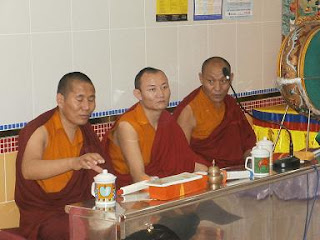
The Karma Norbuling Buddhist Centre (KNBC) had recently held its two-days Amitabha Chang Chok and Mahakala Pujas from 19 August to 20 August 2012 at the association's premises in Alma, Bukit Mertajam. The entire event was conducted by Venerable Khedup Rinpoche with the assistance of his two Lamas from Nepal. The pujas were held in conjunction with the 7th Lunar Month which began on last Friday with the purpose of conducting prayers and to create merits for the deceased, family ancestors, to reduce our karmic effects as well as to pray for the wondering spirits and unborn babies who had passed away prior to birth. Apart from conducting the pujas, Khedup Rinpoche also give a brief explanation on the meaning and reason of this puja was conducted, the meaning and significance of the mantra and sutra chants and a short dharma discourse. Auspicious lamp offering is also part of the event. After the pujas, Khedup Rinpoche led the devotees in transf...

Nishkama

Image
The cultivation of this Paramitas is an important step towards perfection of man. Nishkama does not mean retirement from the world. It actually defines as renunciation of the fruits of one's good actions. Man must endeavour to do his duty in accordance with the light that is given to him and should not concern himself with the success and failures of his efforts. Duty must be done without fear and favour and without regard to any hazards that man may run for himself. But where others are concerned he must use its forbearance and the gift of persuasion to its very limit. He must also wisely avail of all the opportunities that come his way, should these be fair. He should plan and work for success and for achieving it need to acquire perfection in his art but should misfortune assail him, he should remain undaunted and cheerful. He must not on any account lose heart. Nishkama presupposes a spirit of spontaneity in the man. Choice of good should become a habit with him, it mu...