Posts

Showing posts with the label Buddha's Enlightenment

Peace, Happiness and Salvation

Image
Today, the message of peace of this Great Teacher is more important than ever before particularly at the time when human beings are intoxicated with power, greed, jealousy, pride, racism, extremism and craving for world domination. This teacher was born in this world to dispel the darkness of ignorance and to save the world from its ills. It is a common knowledge that throughout the world, many people continue to live without practising any form of noble life. However, if they would make an effort to study and understand what this Great Teacher had taught, they could clarify their doubts and be convinced of his teachings that could best contribute to find the aim of life. Whether one believes in him or otherwise, his teaching had a profound effect on everyone. His message was spread without any violence nor war. It is a significant fact that not a single drop of blood had ever been shed in his name or in the name of his teachings. This is indeed the most remarkable record in the wor...
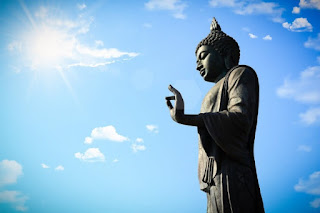
Why should we have faith in the Buddha?

Image
Why should we have faith in the Buddha as our refuge? To get the answers, you should first need to know about the Buddha’s life only then we can understand why the Buddha was an exceptionally noble individual who has unrivalled as the most supreme being in the three worlds. Why should we have faith in him as the teacher of human beings, deities and celestial beings? Stated simply, he is worthy of faith because he discovered and showed all these beings the way leading to cessation of suffering. To understand why the Buddha is worthy of such faith, we should understand the intrinsic meaning of the word Buddha. In other words, Buddha means “the one who knows”. If we look at the actual meaning in Pali word, it says “bujjhatiti buddho”, whereby when it is transalated in English, it says, “because he knows, he is called Buddha”. What does he know? He knows the true nature of phenomena. Therefore, Buddha means “one who knows true nature”. In this world, what are all beings looking for? The...

The Discourse on the Great Blessings

Image
What a blessing is was thought about by gods and men for twelve years but they did not attain true safety, the thirty eight blessings which were preached by the gods of gods make all that is bad perish. For the entire world’s benefit and welfare, we will recite that safeguard. The Safeguard Thus I have heard: at one time the Gracious One was dwelling near Savathi at Ananthapindika’s grounds in Jeta’s Wood. Then a certain god towards the end of the night, having lit up the whole of Jeta’s Wood with his surpassing beauty, approached the Gracious One and upon approaching and worshiping the Gracious One, he stood on one side. While standing on one side that god addressed the Gracious One with a verse: “Many are the gods and the men who have thought about the blessings hoping for safety, now please say what is the supreme blessing”. “Not associating with fools but associating with the wise; honouring those worthy of honour: this is the supreme blessing. Living in a suitable place, former...

About Compassion

Image
In Buddhism, we are taught not only to love, but that our love also needs to arise from a mind of sincerity, purity and equality. We call this kind of love compassion. Compassion is a rational love. We also need to use true wisdom. Wisdom is the true mind and emotion is the illusory mind. Love that arises from emotions will change while love that arises from wisdom will change while arises from wisdom will never change. Therefore, the Buddhas do not use love but instead compassion is used. On appearance, love and compassion seem to be the same but their intentions are different. Love may change to hatred but with wisdom, love will never change. All Buddhas and Bodhisattvas will love us no matter what happen; whether we love or hate them, becoming jealous or slandering, harming or destroying them. Their compassion for us will never change. This is true love. Most of us will find that our six sense become polluted when they encounter external surroundings. When they are pleasing...

Understanding the Principles

Image
When we observe all the worries, pain, bitterness, anger, good fortune, misfortune, good, evil, conflicts, confrontations and natural disasters around worldwide, we see that they are due to wrong understanding of the truth about life and the universe. From this misunderstanding, we erroneously generate emotional attachments, differentiate between others and ourselves, expand the conflicts and confrontations within ourselves to all beings, affairs, objects and the natural environment outside ourselves. This is why we are making disasters worsening everywhere. In reality, natural disasters are caused by human minds. The Buddha said, "greed is the cause of flood, anger is the cause of fire, ignorance is the cause of wind, arrogance and inequality are the cause of earthquakes". Once we understand the fundamental principles, we will understand that everything in this world and beyond arises from the mind and changes according to our perceptions. If we seek to become Buddh...

Buddha-name Chanting Helps! The Proper Thought

Image
Some people may say that when one chants mantras, one will also get help from the Buddhas and Bodhisattvas. Indeed, when chanting mantras as practiced by Esoteric schools, the Buddhas and Bodhisattvas will also be there to help but it is not as good as chanting the name of Amitabha Buddha. When one chant mantras, one will have the help of one or two Buddhas or Bodhisattvas. To get the help of three to five Buddhas and Bodhisattvas is incredible. But when one mindfully chants the name of Amitabha Buddha, one will obtain the help of all Buddhas in the 10 directions and in the three time periods. This is why the merit of chanting the Amitabha Buddha's name is inconceivable. What does the proper thought arising means? It is "Amituofo": the most truthful and ultimate proper thought. The only important issue in our life is to constantly maintain proper thoughts, not to cling to deviated or erroneous ones and to be constantly mindful of Amitabha Buddha day and night witho...

The Practice of Pure Land

Mr Li Bingnan often said that only two or three out of ten thousand Pure Land practitioners are able to actually attain rebirth. It is because these two or three practitioners truly believe, accept and practice, while the other do not really do that. These 9997 practitioners chant with their mouths only and are not mindful in their chanting. They have yet to eliminate their afflictions and residual habits. they are still attached to fame, prestige, gain, wealth, the 5 Desires and the 6 Dusts. When this is the case, even the Buddhas cannot do anything to help these people. Those who can accept the Pure Land method possess great roots of goodness, good fortune and good causes as well as conditions. If we did not really have the best root nature, it would be impossible for us to accept the Buddha Mindfulness Chanting method. Those who can accept it and practice earnestly can neutralize the transgressions accumulated over infinite lifetimes with the merits of their chanting. The Pur...

Healthy Doubt Versus Vacillating Doubt

The first thing that the Buddha told the Kalamas was that it was right for them to be perplexed and doubtful when a matter that arouses perplexity has arisen. Given the frustration of the Kalamas this opening statement of the Buddha is well placed and understandable. But the Buddha did not mean this as merely a consolation for the Kalamas in order to put them at ease. More than that it also serves as an encouragement to ask questions and seek knowledge when in doubt. For within the Buddha's teaching itself there is a room for healthy doubting which serves as a catalyst for the search after knowledge and truth. This kind of doubt should be differentiated from the vacillating doubt that constitutes a hindrance to the practice of meditation. Vacillating doubt is an unwholesome state of mind closely allied with delusion, the combination of both which gives rise to a confused and debilitating mental vacillation that leads to mental paralysis. The mind that is plague by vacillatin...

The Importance of Bodhicitta

Image
The highest perfection of altruism, the ultimate altruism, is bodhicitta complemented by wisdom. Bodhicitta, the aspiration to bring about the welfare of all sentient beings and to attain buddhahood for their sake, is really the distilled essence, the squeezed juice, of all the Buddha's teachings, because ultimately the Buddha's intention is to lead all sentient beings to perfect enlightenment, complete omniscience. Since it is bodhicitta that determines whether or not our practice becomes the path to enlightenment, bodhicitta is truly the heart essence of all the teachings of the Buddha. Thus, all 84,000 discourses of the Buddha can be seen as either preliminary to the practice of bodhicitta, the actual practice of bodhicitta, or precepts and activities in which we must engage as a result of taking the bodhicitta pledge. When we come to recognise all this, we will really appreciate the preciousness of our human existence, which gives us the ability to reflect on and exp...

Floods of View and Ignorance

Image
There are two other floods: of view (ditthogha) and of ignorance (avijjogha). "Views" refer to the instinct we have to hold beliefs, opinions and dogmas in order to gain a standpoint. They could be anything from "Buddhism is the best religion" to "The liberal party is fair and just and seeks for the welfare of the nation" to "Women are hopeless drivers" to "Our nation is the source of truth and harmony in a brutal world". Or a view could be a lot more personal, "I am a Taurus and that means that I will get on well with Scorpios". Such broad-brush generalisations form an easy basis for our decisions, loyalties and world-view. And so, throughout history, societies have adopted views such as, "There are witches who consort with the devil and bring blight onto the crops and plague into the city". Or they have adopted the view that Jews are a contamination and should be eradicated; or that communists are infiltrating...

Daily Perfections

Image
The reason why this set was put together, some years after the Buddha passed away, seems to have been that Buddhists speculated on why this one person arose in the world who surpassed all toehr in the depth and range of his wisdom. Many of his disciples developed qualities that the Buddha had manifested and also crossed over to the Other Shore but none came close to the Buddha in terms of depth, range and versatility in presenting the Dhamma. And unlike his disciples, he realized the path without a teacher. So people reckoned that this unique person must have interited a huge stock of strengths and virtues in the process of many lifetimes. Stories and fables were created to describe this process whereby the Future Buddha (Bodhisatta or Bodhisattva) developed parami as foundation for his future enlightenment (or awakening). Different schools of Buddhism selected different qualities to be parami, but in the school that came to be called Threvada, then were so designated. Theravada...

Observing The Law Of Karma

Image
Upon taking refuge in the Three Jewels, your main responsibility is to observe the law of karma and abstain from the ten negative actions. Moreover, your success in doing so depends on your considering thoroughly which are the black or white karmic actions together with their results and then living accordingly to the guides of what is to be adopted or rejected. There are different kinds of karmic actions ad various ways of categorising them. Since we all share the same fundamental nature, which is the natural aspiration to be happy and not to suffer, actions leading to happiness are generally considered to be positive or virtuous, while actions leading to pain and suffering are generally considered to be negative or non-virtuous. Therefore, it is in their causal relationship to happiness and suffering that the distinction between positive and negative or virtuous and non-virtuous actions is made. With respect to the medium through which these positive and negative actions are c...

Wesak Day 2013

Image
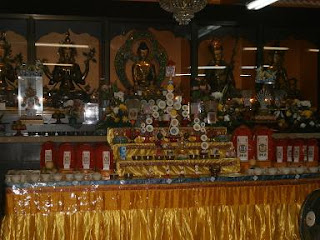
Karma Norbuling Buddhist Centre (KNBC) which is situated in Alma, Bukit Mertajam has held its Wesak celebration from 23rd May to 24th May 2013 commencing with the Buddha Bathing and Circumambulation ceremony on the Wesak Eve Night and followed by Liberation of Live, Lamp Lighting and the 16 Arahant Puja. Members and devotees of KNBC later joined in the Wesak float procession at about 6.00 pm in the Bukit Mertajam town centre. Meanwhile at Cherok To'kun, also in Bukit Mertajam, Nandaka Vihara Meditation Society also held its Wesak celebration with numerous activities, which includes, Dharma Talk, Dana, Sanghikadana and Chanting of Suttas. The celebration also includes other merit making activities, like Offering of Robes and Sangha Requisites by the devotees.

Developing Faith In Karma

Image
According to the Buddhist tradition, the subtlest workings of karma are evident only to the omniscient minds of the Buddhas; ordinary beings have no way of understanding karma as its deepest levels. Therefore, in order to be deeply convinced of the truth of the law of karma, you need to have a deep conviction in the validity and efficacy of the Three Jewels of Refuge; the basis of your spiritual practice must be strong faith in Buddha, Dharma and Sangha. This faith is not developed from the words of the Buddha alone but, as we have seen, on the basis of your own critical analysis. If you look at the Buddha's teachings, you can discern two basic objectives: the secondary, temporary objective is to help sentient beings gain upper rebirths, but the primary, ultimate objective is to lead them to complete liberation from samsara. When you examine the Buddha's teachings on the complex issue of negative emotions and how to counter them, you can see that these matter are evident...

The Objects of Salutation

Image
The objects of salutation in this verse - the conquerors of the three times - are the Three Jewels of Refuge. It is important to pay homage to the Buddha not as just some noble object but in terms of the meaning of jang-chub. The Sanskrit term for jang-chub is bodhi, which conveys a sense of awakening, a state where knowledge and realization have been perfected. Therefore, when explaining the meaning of awakening or enlightenment, we can speak about both process by which this awakening takes place and the state to which awakening brings us; in other words, the means and fruition. When we understand enlightenment as resultant state, we are primarily referring to the enlightened quality of purity - the perfected state where all negativities and limitations have been purified. There's another aspect to this purity, which is the primordially pure nature of the enlightened state. The reason why enlightenment is a perfected state where all obscuration has been purified is because na...

Investigating The Nature of Reality

Image
All this suggest the importance of having a deeper knowledge of the nature of the mind and its various aspects and functions in general and the nature and complexity of emotion in particular. Also since we realize that many of our problems arise from a fundamentally flawed way of perceiving and relating to the world, it becomes important for us to be able to examine whether or not our perception accords with the true nature of reality. Understanding the true nature of reality is crucial as it is our perception of reality that lies at the heart of how we relate to the world. However, reality here means not just the immediate facts of our experience and environment but the entire expanse of reality because many of our thoughts and emotions arise not only as a result of the immediate physical environment but also out of abstract ideas. Therefore, in the Buddha's teaching, we find a great deal of discussion on the nature of reality in terms of eighteen constituents, the twelve s...

Intellectual and Experiential Understanding

Image
It is important to be able to differentiate between two levels of understanding, one is the superficial, intellectual level, where on the basis of reading, studying or listening to teachings, we distinguish between negative and positive qualities of mind and recognize their nature and origin. The other is the deeper, experiential level where we actually cultivate and generate positive qualities within ourselves. Although it can be challenging to develop an intellectual understanding of certain topics, it is generally easier because it can be cultivated merely by reading texts or listening to teachings. Experiential understanding is far more difficult to develop, since it comes about only as a result of sustain practice. At the experiential level, your understanding is essentially a felt experience. Because experiential understanding is thus accompanied by powerful emotions, you can see that although many emotions are destructive, there are positive emotional states as well. Actu...

Do Not Imitate, Knowing Yourself and Knowing Others

Image
We have to be aware of how people tend to imitate their teachers. They become copies, prints, castings and it is like the story of the king's horse trainer. The old trainer died, so the king hired a new trainer. Unfortunately, this man limped when he walked. New and beautiful horses were brought to him and he trained them exquisitely, to run, to canter, to pull carriages. But each of the new stallions developed a limp. Finally, the king summoned the trainer and seeing him limp as he entered the court, he understood everything and immediately hired a new trainer. As teachers, you must be aware of the force of the examples you set. And even more important, as students, you must not follow the image, the outer form, of your teacher. He is pointing you back to your own inner perfection. Take the inner wisdom as your model and do not imitate his limp. Know your own mind and body and you will know others' as well. One's facial expressions, speech, gestures, actions, all ...

To Grasp a Snake

Image
"Our practice here is not to grasp anything", a chief monk told a young monk. "But isn't it necessary to hold onto things sometimes?", the younger monk protested. "With the hands, yes, but not with the heart", the chief monk replied. "When the heart grasp what is painful, it is like being bitten by a snake and when through desire, it grasp what is pleasant, it is just grasping the tail of the snake. It only takes a little while longer for the head of the snake to come around to bite you. "Make this non grasping and mindfulness the guardian of your heart, like a parent. Then your likes and dislikes will come calling like children. 'I don't like that, mummy. I want more of that, Daddy'. Just smile and say, 'Sure, kid'. 'But mummy, I really want an elephant'. 'Sure, kid'. 'I want candy, can we go for an airplane ride?' There is no problem if you can let them come and go without grasping". ...

The Way of Understanding

Image
Penetration means to enter something, not just to stand outside of it. when we want to understand something, we cannot just stand outside and observe it. We have to enter deeply into it and be one with it in order to really understand it. If we want to understand a person, we have to feel their feelings, suffer their sufferings and enjoy their joy. Penetration is an excellent word. The word "comprehend" is made up of the Latin roots "com", which means "together in mind" and "prehendere" which means "to grasp it or pick it up". To comprehend something means to pick it up and be one with it. there is no other way to understand something. If we only look at the sheet of paper as an observer, standing outside, we cannot understand it completely. We have to penetrate it. we have to be a loud, be the sunshine and be the logger. If we can enter it and be everything that is in it, our understanding of the sheet of paper will be perfect...