Posts

Showing posts with the label Experience

The True Nature and Our Thoughts

Image
If we see someone in need and we unreservedly give him a dollar or more, then the merit of this accords with our true nature because at that time we did not discriminate between others and us. We did not distinguish between the receiver and the donor. We were not attached. In this way, the merits from giving a dollar or more are infinite for they are the uncovering of our virtuous natures. Jealousy and hatred are indeed thoughts of stealing. Why is that so? Because one does not like seeing others doing better. This mindset is abnormal. Wishing others would be worse off or becoming displeased, critical or slanderous when seeing virtuous people or good deeds being carried out - these are all thoughts of stealing. A virtuous person delights upon seeing other virtuous people or good deeds and will wholeheartedly assist these good people and help them accomplish their good deeds. A virtuous person will set a good example for whatever community he is in and his good deeds will certa...

The Three Levels Of Refuge

Image
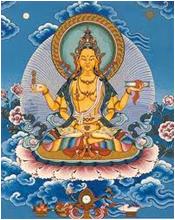
If there is a threat, we should seek refuge from it. Similarly in the context of spiritual practice, to protect ourselves from the threat of an unfavourable rebirth, we should seek refuge in the Three Jewels: Buddha, Dharma and Sangha. Buddhism teaches three different levels of refuge. The first is where we seek protection from the immediate threat of the suffering of rebirth in a lower realm of existence. Inspired by the greater fear that this possibility evokes, we seek refuge in the Three Jewels in order to avoid it. This level of refuge is relevant to initial scope of practitioners, whose goal is to attain an upper rebirth. When we think of the lower realms of existence, we should not think of some place far away in the distant future. All that actually lies between the present moment and the next life is simply the continuity of our breath. The moment we stop breathing, when we breathe out an don't breathe in, the next life is right there in front of us. It is not a m...

Developing Faith In Karma

Image
According to the Buddhist tradition, the subtlest workings of karma are evident only to the omniscient minds of the Buddhas; ordinary beings have no way of understanding karma as its deepest levels. Therefore, in order to be deeply convinced of the truth of the law of karma, you need to have a deep conviction in the validity and efficacy of the Three Jewels of Refuge; the basis of your spiritual practice must be strong faith in Buddha, Dharma and Sangha. This faith is not developed from the words of the Buddha alone but, as we have seen, on the basis of your own critical analysis. If you look at the Buddha's teachings, you can discern two basic objectives: the secondary, temporary objective is to help sentient beings gain upper rebirths, but the primary, ultimate objective is to lead them to complete liberation from samsara. When you examine the Buddha's teachings on the complex issue of negative emotions and how to counter them, you can see that these matter are evident...

The Two Truths

Image
Buddhism discusses what are known as the two truths - the truths of conventional and ultimate reality. The concept of two levels of reality is not unique to Buddhism. It is a common epistemological approach in many of the ancient Indian schools. Followers of non-Buddhist Samkhya school, for example, explain reality in terms of twenty five categories of phenomena. The self [Sanskrit: purusha; Tibetan: kye-bu] and the primal substance [Sanskrit: prakriti; Tibetan: rang-zhin] are said to be ultimate truths, while the remaining twenty three categories of phenomena are said to be manifestations or expressions of this underlying reality. However, what is unique in Mahayana particularly in the Madhyamaka or Middle Way School is that conventional and ultimate truths are not seen as two unrelated, independent entities but as different perspectives of one and the same world. According to the Middle Way School of Buddhism, the ultimate truth or the ultimate nature of reality is the emptine...

The Objects of Salutation

Image
The objects of salutation in this verse - the conquerors of the three times - are the Three Jewels of Refuge. It is important to pay homage to the Buddha not as just some noble object but in terms of the meaning of jang-chub. The Sanskrit term for jang-chub is bodhi, which conveys a sense of awakening, a state where knowledge and realization have been perfected. Therefore, when explaining the meaning of awakening or enlightenment, we can speak about both process by which this awakening takes place and the state to which awakening brings us; in other words, the means and fruition. When we understand enlightenment as resultant state, we are primarily referring to the enlightened quality of purity - the perfected state where all negativities and limitations have been purified. There's another aspect to this purity, which is the primordially pure nature of the enlightened state. The reason why enlightenment is a perfected state where all obscuration has been purified is because na...

Intellectual and Experiential Understanding

Image
It is important to be able to differentiate between two levels of understanding, one is the superficial, intellectual level, where on the basis of reading, studying or listening to teachings, we distinguish between negative and positive qualities of mind and recognize their nature and origin. The other is the deeper, experiential level where we actually cultivate and generate positive qualities within ourselves. Although it can be challenging to develop an intellectual understanding of certain topics, it is generally easier because it can be cultivated merely by reading texts or listening to teachings. Experiential understanding is far more difficult to develop, since it comes about only as a result of sustain practice. At the experiential level, your understanding is essentially a felt experience. Because experiential understanding is thus accompanied by powerful emotions, you can see that although many emotions are destructive, there are positive emotional states as well. Actu...