Posts

Showing posts with the label Compassion

Seeking From Within

Image
Whether attaining something outside of ourselves such as material objects or inside ourselves such as virtues, we still need to seek from within, from the mind. Seeking from outside would be futile. Why? The outside factor is a constant as it cannot change whereas the mind is variable, it can be changed. How do man made calamities, war for example come about? They are from the confrontational and conflicting thoughts in our minds. For example, when there is profit, who do you think of benefiting first? If we think of ourselves first, then it will be difficult to avoid conflicts of interest with others. If everyone thinks of him or herself, how can this world be safe and secure? On the other hand, if everyone can put others before themselves, how can this world be in disorder? Many scientist now believe that everything in this world is composed of elementary particles such as electrons and quarks and that they are all actually tiny particles vibrating at different frequencies. Th...

About Compassion

Image
In Buddhism, we are taught not only to love, but that our love also needs to arise from a mind of sincerity, purity and equality. We call this kind of love compassion. Compassion is a rational love. We also need to use true wisdom. Wisdom is the true mind and emotion is the illusory mind. Love that arises from emotions will change while love that arises from wisdom will change while arises from wisdom will never change. Therefore, the Buddhas do not use love but instead compassion is used. On appearance, love and compassion seem to be the same but their intentions are different. Love may change to hatred but with wisdom, love will never change. All Buddhas and Bodhisattvas will love us no matter what happen; whether we love or hate them, becoming jealous or slandering, harming or destroying them. Their compassion for us will never change. This is true love. Most of us will find that our six sense become polluted when they encounter external surroundings. When they are pleasing...

Developing Merits Inside Us

Image
What is merit? It is purity of mind, concentration and wisdom. Think about it, if we lose our tempers, how can we maintain our concentration and wisdom? It is impossible. As for good fortune, it is our wealth and intelligence. When our mind attains Constant Mindfulness of Buddha Amitabha or One Mind Undisturbed, we can accumulate merits and virtues. But with just one outburst of temper, all is lost i.e. no more Constant Mindfulness of Buddha Amitabha or One Mind Undisturbed. Therefore, we need to remain vigilant so as not to lose our merits. The Buddha once said, if we practice the Ten Virtuous Karmas, we will not fall into the Three Bad Realms. Instead, we would likely be born in the heavenly realms if we practice these good conducts diligently. If we achieve the deep concentration along with the Four Immeasurable Minds of loving kindness [providing happiness to others], compassion [taking away bitterness of others], joy [liberating others from suffering and feeling happy for t...

To Attain Pure Land

Image
According to this criterion, the minimum standard to achieve attainment in Mahayana Buddhism is to rid ourselves of a portion of our attachments, to sever the eighty-eight kinds of deviated thoughts and views. If we cannot sever these, we have not yet achieve attainment. Mahayana practitioners, who successfully sever them, reach the Initial Belief Stage. Theravada practitioners who sever various wrong views reach the stage of Stream-entering. Without these accomplishment, we will still be reincarnating within the cycle of rebirth, still having to repay our debts. However, there is still another way here: to seek rebirth in the Western Pure Land. Otherwise, attainment is not possible. If we cannot go to the Pure Land, we will have achieved nothing at all. Seeking rebirth in the Pure Land is actually much easier than severing the eighty-eight kinds of improper thoughts and views because we do not need to sever all of them, but we can carry our remaining karma with us. As long as...

Floods of Sensuality and Becoming

Image
The first flood to note is he current that accompanies the senses of emotional impressions of their desirability or interest. This is the flood of sensuality (kamogha), a torrent under whose trance sense objects seem to offer pleasant sights, sounds, tastes, fragrances and touches. With some experience and considered attention, we can note that some of these, once seen, heard, etc, actually induce the kind of feeling that the current promises in any but the most fleeting way In the gentle or pulsing waves of this flood however, the objects of the sense seem irresistible, charming and productive of real satisfaction. And yet the manifest truth of our lives is that we are not blissed-out or even satisfied for long in any sense of contact. It happens all day long and with luck it is mostly okay. Sometimes it is pleasant for a little while and sometimes it is unpleasant, but the pleasant, once established, gets to be normal and then became boring after some time. So, desire for newe...

Oppose Your Mind

Image
Consider the Buddha's compassion and skill. He taught us after his own enlightenment. Finished with his own business, he got involved in ours, teaching us all these wonderful means. Concerning practice, we need to follow him, we need to carry out all efforts in seeking and giving as we believe what the Buddha has taught us, that Path, Fruition and Nirvana exist. But these things are not accidental. They arise from right practice, from right effort, from being bold, daring to train, to think, to adapt and to do. These efforts involve opposing your own mind. The Buddha says not to trust mins because it is defiled, impure, does not yet embody the virtue or Dharma. In all different practices we do, we must therefore oppose this mind and when the mind is being opposed, it becomes hot and distressed and we begin to wonder whether we are on the right path or otherwise. Because practice interferes with defilement, with desire, we suffer and may even decide to stop the practice. Th...

Attitude

Image
Within the last century, western science and physics have made a startling discovery. We are part of the world we view. The very process of our observation changes the things that we observe. For example, an electron is an extremely tiny item. It cannot be viewed without instrumentation and that apparatus dictates what the observer will see. If you look at an electron in one way, it appears to be a particle, a hard little ball that bounces around in nice straight paths. When you view it in another way, an electron appears to be a wave form, with nothing solid about it. It glows and wiggles all over the place around it. An electron is an event more than a thing. And the observer participates in that event by the very process of his or her observation. There's no way to avoid this interaction. Eastern science has recognized this basic principle for a very long time ago. The mind is a set of events and the observer participates in those events every time he or she looks inward....

Drupon Samten Rinpoche chants for the liberation

Image
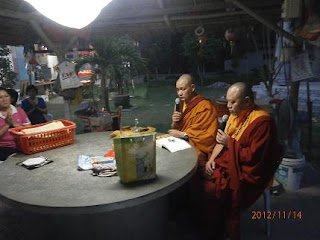
Today, Drupon Samten Rinpoche held a chanting session for the liberation of fish into the river in front of the Palme Gon Buddhist Society premises. After the liberation, the passing of merits was also conducted in order to ease the suffering of the wandering spirits, as well as for the benefit of all beings.

The Wrong Road

Image
A wandering ascetic, having heard of the Buddha, travelled everywhere looking for him. One night, he came to stay in a house where the Buddha was also residing but not knowing the Buddha's physical appearance, the ascetic was clearly unaware of the Buddha's presence. The next morning, he arose and continued his journey to search for the Buddha no knowing that he was in his neighbourhood the whole night. To search for peace and enlightenment without correct understanding is like this. Due to lack of understanding of the truth of suffering and its elimination, all subsequent factors on the path will be wrong i.e. wrong intentions, wrong speech, wrong actions and wrong practice of concentration and tranquillity. You likes and dislikes are not a trustworthy guide in this matter either, although foolish people may take them for their ultimate reference. Alas, it is like travelling to a certain town, you unknowingly start out on the wrong road and since it is a convenient on...

The Middle Way

Image
The Buddha does not want us to follow the double path - desire and indulgence on the one hand and fear and aversion on the other side. Just be aware of pleasure, he teaches. anger, fear, dissatisfaction are not the path of the yogi but the path of the worldly people. The tranquil person walks the Middle Path of right practice, leaving grasping on the left and fear and aversion on the right. One who undertakes the path of practice must follow this Middle Way i.e. "I will not take interest in pleasure or pain. I will lay them down". But, of course, it is hard at first. It is as though we are being kicked on both sides. Like a cowbell or a pendulum, we are knocked back and forth. When the Buddha preached his first sermon, he discoursed on these two extremes because this is where attachment lies. The desire for happiness kicks from one side; suffering and dissatisfaction kick from the other. these two are always besieging us all the time. But when you walk the Middle Path,...

We Are All Linked to Each Other

Image
Millions of people follow sports. If you love to watch soccer or baseball, you probably look for one team and identify yourself with them. You may watch the games with despair and elation. Perhaps, you will give a little kick or swing to help the ball along. If you do not take sides, the fun is certainly missing. In wars, we also pick sides, usually the side that is being threatened. Peace movements are born of this feeling. We get angry, we shout, but rarely do we rise above all this to look at a conflict the way a mother would, who is watching her two children fighting. She seeks only for their reconciliation. In order to fight each other, the chicks born from the same mother hen put colours on their faces. Putting colours on our own face is to make ourselves stranger to our own brothers and sisters. We can only shoot each other when they are strangers. Real efforts for reconciliation arise when we see with the eyes of compassion and that ability comes when we clearly see that...

Meditation on Love

Image
The mind of love brings peace, joy and happiness to ourselves and others. Mindful observation is the element which nourishes the tree of understanding and compassion and love are the most beautiful flowers. When we realize the mind of love, we have to go to the one who has been the object of our mindful observation, so that our mind of love is not just an object of our imagination but a source of energy which has a real effect in the world. The meditation on love is not just sitting still and visualizing that our love will spread out into the space like waves of sound or light. Sound and light have the ability to penetrate everywhere and love and compassion can do the same. But if our love is only a kind of imagination, then it is not likely to have any real effect.  It is in the midst of our daily life and in our actual contact with others that we can know whether our mind of love is really present and how stable it is. If love is real it will be evident in our daily...

Meditation on Compassion

Image
Love is a mind that brings peace, joy and happiness to another person. Compassion is a mind that removes the suffering that is present in the other. We all have the seeds of love and compassion in our minds and we can develop these fine and wonderful source of energy. We can nurture the unconditional love that does not expect anything in return and therefore does not lead to anxiety and sorrow. The essence of love and compassion is understanding, the ability to recognize the physical, material and psychological suffering of others, to put ourselves inside the skin of the other. We go inside their body, feelings and mental formations and witness for ourselves their suffering. Shallow observation as an outsider is not enough to see their suffering. We must become one with the object of our observation. When we are in contact with another's suffering, a feeling of compassion is born in us. Compassion means literally, :to suffer with". We begin by choosing as the object our...

What Is Not Wrong?

Image
We always ask, "What is wrong?" Doing so, we invite painful seeds of sorrow to come up and manifest. We feel suffering, anger and depression and produce even more of such seeds. We could be much happier if we tried to stay in touch with the healthy, joyful seeds inside and around us. We should learn to ask, "What is not wrong?" and be in touch with that. There are so many elements in the world and within our bodies, feelings, perceptions and consciousness that are wholesome, refreshing and healing. If we block ourselves, if we stay in the prison of our sorrow, we will not be able to be in touch with these healing elements. Life is filled with many wonders, like the blue sky, the sunshine, the eyes of a baby. Our breathing, for example, can be very enjoyable. I enjoy breathing everyday. But many people appreciate the joy of breathing only when they have asthma or a stuffed up nose. We do not have to wait untul we have asthma to enjoy our breathing. Awareness...

Living Together

Image
When we live with another person, to protect each other's happiness, we should help one another transform the internal formations that we produce together. By practicing understanding and loving speech, we can help each other a great deal. Happiness is no longer an individual matter alone. If the other person is not happy, we will not be happy either. To transform the other person's knots will help bring about our own happiness as well. A wife can create internal formations in her husband and a husband can do so in his wife and if they continue to create knots in each other, one day, there will be no happiness left. In this case, as soon as a knot is created, the wife, for instance should know that a knot has just been tied onto her. She should not overlook it. She should take the time to observe it and with her husband's help, transform it. She might say, "darling, I think we would better discuss a conflict I saw growing". This is easy when the states of...

The River of Feelings

Image
Our feelings play a very important part in directing of our thoughts and actions. I us, there is a river of feelings, in which every drop of water is a different feeling and each feeling relies on all the others for its existence. To observe it, we just sit on the bank of the river and identify each feeling as it surfaces, flows by and disappears. There are three kinds of feelings, pleasant, unpleasant and neutral. When we have an unpleasant feeling, we may want to chase it away. But it is more effective to return to our conscious breathing and just observe it, identifying it silently to ourselves: "Breathing in, I know there is an unpleasant feeling on me. Breathing out, I know there is an unpleasant feeling on me". Calling a feeling by its name, such as anger, sorrow, joy or happiness, helps us identify it clearly and recognise it deeper. We can use our breathing to be in contact with our feelings and accept them. If our breathing is light and calm, a natural result ...

Discover it from inside

Image
To speak most correctly, we cannot really learn from scriptures, from techniques or from those various teachings if we are to be truly successful. To successful reap any benefits for real, we must learn in the thing itself, namely the actual prison. Study the actual dukkha in itself, that prison itself. So, we would better look for and find this prison, which is what are we going to talk about. At this point, we are confronted by two choices: are you going to learn from outside or are you going to learn from inside? The distinction is crucial. The Buddha said that we must study from inside. The external learning is from books, ceremonies, practices and things like that. Everything that we must learn, the Tathagata has explained in terms of the body which is still alive. That means a living body, with a living mind, not a dead one. That's where real learning takes place, so learn there. Learn from that inside, which means learn within yourself while you are still alive, befor...

Zambhala Puja

Image
Zambhala is a wealth deity and an emanation of Buddha Ratnasambhava. He has increasing quality and is the essence of generosity. His aspirations are to help the poor and those suffering from ill torture. There are five Zambhala : red, yellow, black, white and green. Zambhala vows to bring wealth, prosperity, success and fortune to sentient beings and to destroy obstacles. He also increases spiritual wealth including luck, long life and wisdom intelligence. Benefits of the Five Zambhala Wish-fulfilling Wealth Vase and Zambhala Wealth Pouch The five Zambhala Wish-fulfilling Wealth vases (contain many holy substances such as life woods, mantra rolls, holy pills and relics, medicines, precious metals and stones, five colours cloths, etc) and the Zambhala Wealth Pouches (contain precious stones, Zambhala pendants and mantras, medicines, etc) will be blessed during the Zambhala Puja. These vases and pouches are believed to possess the positive energy to attract luck and fortune. A...

Manjushri Empowerment

Image
The empowerment of Buddha Manjushri is an opportunity to receive special blessing from the Wisdom Buddha so as to develop and increase our own inner wisdom. This wisdom has the power to answer all of our questions, and overcome our doubts and hesitation. In particular, the wisdom that realizes ultimate truth has the power to liberate us once and for all from the bondage of our ignorance and bestow upon us the everlasting joy of enlightenment. Awakening to the ultimate truth of how things really exist is the path to permanent inner peace.

Chenrezig Empowerment

Image
Chenrezig is looked upon as the manifestation of the loving-kindness and compassion of all Buddhas and Bodhisattvas. He has a special affinity with beings in samsara  and can manifest into various forms to help beings who are in varying kinds of needs. The Buddha prophesied that : The Great Compassionate Bodhosattva (Guan Shi Yin Pusa) will manifest as Karmapa to liberate all sentient beings from samsaric sufferings. Therefore, the practice of Chenrizig is particularly very important in the Karma Kagyu Lineage. Om Mani Padme Hung, the six-syllable mani mantra of Chenrezig represents the loving-kindness and compassion of all Buddhas and Bodhisattvas manifested as sound. Chanting the mantra is like practicing the six perfections and is able to close the doors to the six realms. In this life, one is able to remove obstacles, have success in life, harmony in family, healthy and prosperous, and all wishes fulfilled. In the next life, it is certain that one will be able to take ...