Posts

Showing posts with the label Three Refuge

Why do we go to the Buddha for refuge?

Image
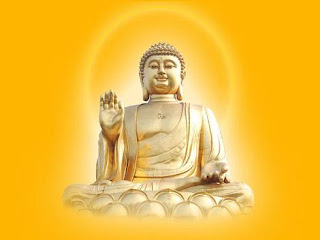
When those who believe in a god experience fear, sorrow or any disturbance in their life, they pray for help and protection. Many Buddhists as whom they can turn to when they are confronted with such situation. In such situation, Buddhists can recall the Buddha to their mind to seek solace. There is no doubt that the Buddhist concept of god differs from that of other religions but when they contemplate the supreme qualities of the Buddha, his great achievements and his calm and noble characteristics, their minds will be calmed and they will gain confidence. Even many religions also say god is not a person, but a force which is personalised in the mind. When their minds are calmed and strengthened by focusing on this power, they will be in the position to face the disturbances to evaluate the problems and find the means to resolve them. Buddhists can resolve their problems in a same manner by recalling the image of the Buddha. Naturally many of our problems are caused by the mind and...

The Three Conditions and Mindfulness

Image
If one does not have the Ten Virtuous Karmas as a foundation for one's learning and practice, one will not be able to attain rebirth in the Western Pure Land even though one practices Buddha-name chanting. How do we know this? It is mentioned in the Visualization Sutra that one should first cultivate the Three Conditions before [beginning to] cultivate the pure karma to go to the Pure Land. The Three Conditions are the foundation of the Mahayana Buddhism. Without such foundations, one will not succeed in one's cultivation and learning, regardless of which Dharma door one learns and practices. The Three Conditions are the common foundation. They are the "true causes - the pure karmas - that the Buddhas of the three time periods cultivate to attain Buddhahood". The three time periods refer to the past, present and the future. there are innumerable Dharma doors that enable one to attain Buddhahood. all the Dharma doors are based on the foundation of the Three Con...

The Three Levels Of Refuge

Image
If there is a threat, we should seek refuge from it. Similarly in the context of spiritual practice, to protect ourselves from the threat of an unfavourable rebirth, we should seek refuge in the Three Jewels: Buddha, Dharma and Sangha. Buddhism teaches three different levels of refuge. The first is where we seek protection from the immediate threat of the suffering of rebirth in a lower realm of existence. Inspired by the greater fear that this possibility evokes, we seek refuge in the Three Jewels in order to avoid it. This level of refuge is relevant to initial scope of practitioners, whose goal is to attain an upper rebirth. When we think of the lower realms of existence, we should not think of some place far away in the distant future. All that actually lies between the present moment and the next life is simply the continuity of our breath. The moment we stop breathing, when we breathe out an don't breathe in, the next life is right there in front of us. It is not a m...

Buddhist Rituals

Image
Buddhism in practice is more colourful than just learning about the Buddha's life and his teachings. It includes many observances, some of which are common to all Buddhist while the other characteristic of a particular culture or country. As we are beings of both reason and emotion, devotional rituals are important in helping us emotionally connect to the Buddha and his teachings. Rituals can bring meaningful solemnity into practice, helping us to focus and attain calmness. These should be done out of sincere faith, not fear or superstition. Shrine The shrine found in Buddhist homes or temples is a focal point of Buddhist observance dedicated to the Triple Gem. The Buddha image in the center of the shrine represents and remind us of the Buddha and the ideal of Enlightenment and its perfect qualities of Wisdom and Compassion among many others. It helps to inspire us as we recall the greatness of the Buddha and his teachings. The shrine may also include other objects such as volume o...

Offerings to the Buddha

Image
During the time of Gotama Buddha, devotees were privileged to offer alms to the Buddha in person. But today, the Buddha is no more with us in person. So we have to learn from the text how to offer alms in devotion to the Buddha. First you must prepare alms food enough for one bhikkhu and place it in front of a statue of the Buddha. If there happens to be no statue nearby, you can through reverence create a mental image of the Buddha and offer alms to that image. Then you must dedicate your cetana to the Buddha in person. After such offering, the alms food may be given to a devotee who does voluntary service in keeping the pagoda precinct clean and tidy, whether he is lay or a bhikkhu. A voluntary worker who keeps uposatha sila (eight precepts) can eat the alms food before doing any service if the noon time is drawing near. At the time of great ceremonious charity if one wishes to offer alms food to the Sangha led by the Buddha, the same procedure should be adopted to make offering of a...

Sanghika Dana (Charity meant for the order of the Sangha)

The Pali word of Sanghika Dana means offering alms and other requisites to the Order of the Sangha. Supposed you donate one dollar to an association, all members rich or poor are entitled to that one dollar. Similarly, if a bowl of alms food or a set of robes is offered to the Sangha, then all members of the order are entitled to those offertories. You need not go around the world to give alms to the Sangha Order. An offer to any member of the Sangha in general will automatically amount to Sanghika Dana. All members are entitled to such offertories. They can share it between them. How to project one's goodwill? In offering Sanghika Dana, a donor's mind must be directed to the Order of the Sangha in general. Even though you utter Samghassa demi , I offer it to the Order of Sangha, if you have in mind a particular monk or a particular monastery, your charity cannot be Sanghika Dana. Offering alms food to any monk on daily alms-round or to a certain monk designated by the Order of...

Taking your Refuge to the Buddha, Dharma and Sangha

Image
The simplest expression of one's intention of taking the Threefold Refuge in the Triple Gem as refuge is by repeating the following lines three times: I go to the Buddha for refuge; I go to the Dharma for refuge; I go to the Sangha for refuge. These lines can be repeated by one alone before an image of the Buddha or repeated line by line after a monk or nun. The formal ceremony is very simple, but it is the commitment that one has in the heart that truly matters. A Buddhist may repeat the Threefold Refuge daily to remind himself that he has made a commitment to attain the goal of happiness and Enlightenment through the guidance and inspiration of the Triple Gem. Benefits of Taking Refuge Taking the Threefold Refuge is the first step on the path to Enlightenment. Therefore, through Moral Conduct and Mental Development, Self-Mastery, Wisdom and Compassion is achieved. Even if Enlightenment is not achieved in this life, one who takes the Threefold Refuge is more likely to have favoura...

Taking Refuge

Taking Refuge means to "return and to rely". From where do we return from and to what we do we rely upon? When we take refuge in the Buddha, we are returning from our deluded state of mind and relying upon an Awakened and Understanding mind. When we take refuge in the Dharma, we are returning from deviant view and understanding. When we take refuge in the Sangha, we are returning from pollution and disharmony and relying upon Purity of Mind and the Six Principles of Harmony. Taking refuge in the Triple Jewels restores the complete wisdom and abilities of our Self-Nature. We will attain purity, equality, honesty, contentment, compassion and overall true happiness.